
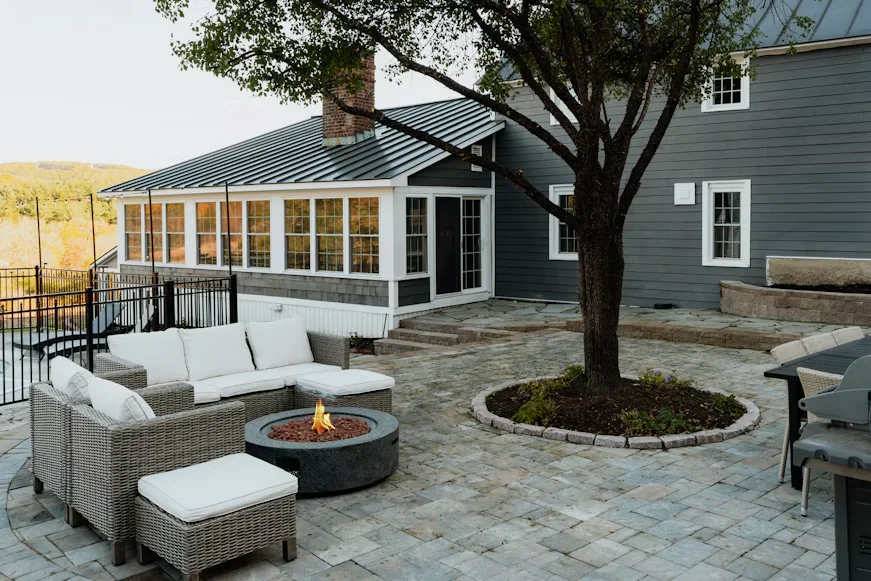
If you are planning a patio in the Milwaukee area, the first decision is usually pavers or a poured concrete slab. Both can look good on day one. The real question is how they handle a Wisconsin winter, year after year, on clay soil that holds water and freezes solid.
What winter does to a patio
Water in the soil freezes and expands, then thaws and settles, over and over from November to March. Clay soil, which most Milwaukee area lots sit on, holds that water longer than sand. Anything built on top of it gets pushed up and dropped back down every winter. That movement is called frost heave, and it is behind most cracked slabs and sunken patios in the area.
How pavers handle it
A paver patio is hundreds of individual units locked together by joint sand and an edge restraint. When the ground moves a little, the pavers move with it instead of cracking. If one area settles over time, the pavers there can be lifted, the base fixed and the same pavers reset. There is no visible patch.
How poured concrete handles it
A concrete slab is one rigid piece. Control joints help it crack in straight lines instead of random ones, but when the ground moves, a slab cracks. Patching concrete rarely matches the original, and a heaved section usually means cutting it out or replacing the slab.
The base matters more than the surface
Here is the part most people never hear. Pavers on a thin base will heave just like concrete. Concrete on a well built, well drained base lasts much longer than concrete poured on soft dirt. What decides how long a patio lasts is what is under it. That means digging out soft soil, building a compacted gravel base in layers and pitching the surface so water runs away from the house. Our paver patio page explains how we build that base.
Salt and winter use
If you shovel and salt the patio or a walk next to it, quality concrete pavers generally handle salt well. Concrete slabs, especially newer ones, can scale and flake when salted heavily. Either way, use less salt than you think. UW Madison salt guidance shows how little it takes (UW Madison salt guidance).
Looks and options
Pavers come in many shapes, colors and textures, plus clay brick and natural stone options. They also work well with matching walkways, borders and a built in fire pit. Concrete can be colored or stamped, but stamped patterns are surface only and show wear and cracks over time.
Which should you choose
- Choose pavers if you want a patio you can repair without a visible patch and that flexes with Wisconsin winters.
- Choose concrete if you want a plain, simple surface and understand it will likely crack at some point.
- Whichever you pick, insist on a proper excavated, compacted base and drainage away from the house.
- Call Diggers Hotline (Diggers Hotline) before any digging, or make sure your contractor does.
We build paver patios, walkways, retaining walls and fire pits across the Milwaukee area. See our hardscaping services or call 262-400-2085 for a free estimate.